Memorialising Trump
Making Donald Great Hereafter

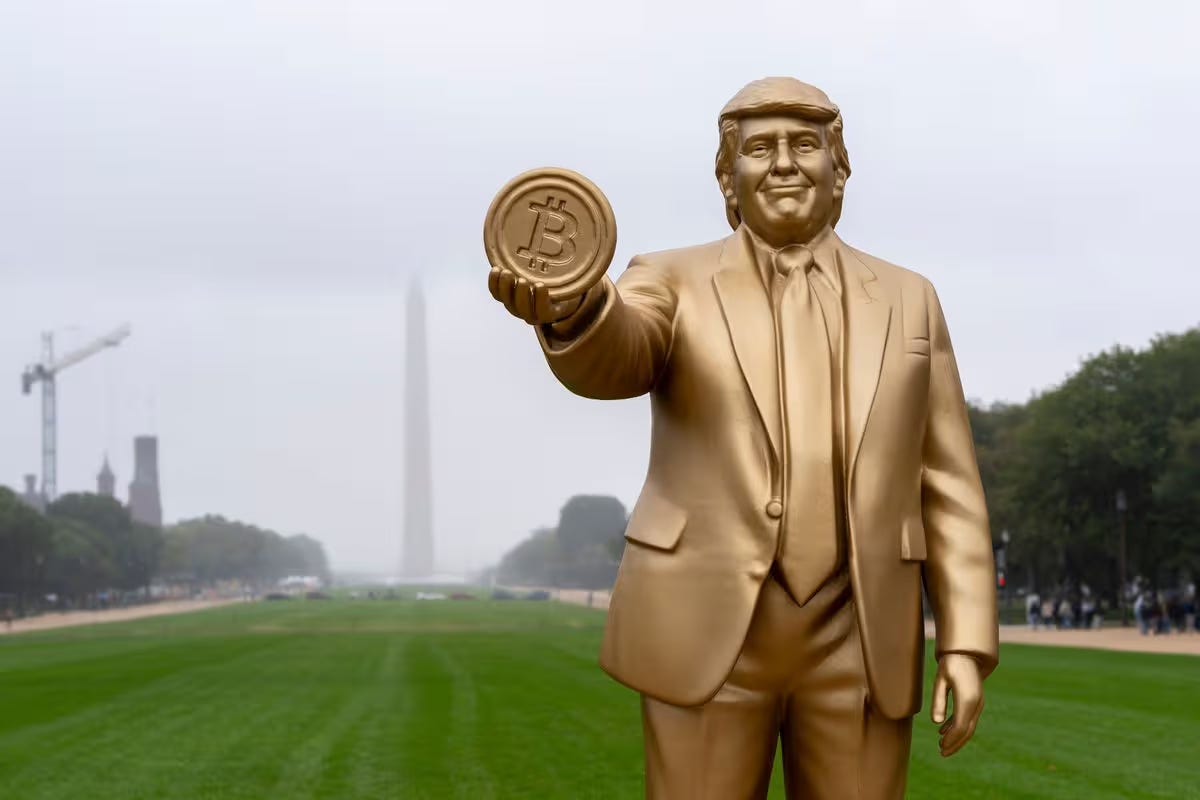
Image?: AP
Rival opinions about Trump have become increasingly divergent as more of us have been forced to think about him: the unprincipled grifter leading a shambolic regime that is responsive only to his personal vanity (and the people with whom he has made a deal); or the game-changing US leader who is breaking convention to Make America Great Again.
This divergence now seems to be at a critical pitch (although of course, we have already passed many critical pitches, so I stand to be corrected). Widespread condemnation of the Iran ‘policy’, which seems to be producing ever more pointlessly dreadful consequences, bears no obvious relationship to the increasingly elaborate attempts to memorialise a president said to be of immense consequence (in a good way).
It is possible that this frenzied memorialisation is a more or less unconscious reaction to the accelerating policy failures, but I don’t know him so wouldn’t want to say. What is clear though is that memorialisation is a funny thing.
In our own culture wars the choice to memorialise or not, or to de-memorialise, is routinely presented as writing, re-writing or air-brushing history. But these are two different things.
For example, I can’t think of a statue of Henry VIII although he is hardly absent from our history. And it took more than 200 years to give Oliver Cromwell a public memorial although when it came it was grand and placed prominently outside Parliament, where Henry most definitely isn’t. Anne Boleyn only got a statue in 1967, and only in Carshalton. It was made of wood and needed restoration only a bit more than 50 years later. Neither of them were absent from history in the meantime, nor during restoration, and a wooden statute in Carshalton (no offence) does not seem a sure guarantee of being in the historical record. And where, we may ask, is the statue of Derek Dougan?
Deciding to put up a memorial is a civic question, in other words, to do with prevailing political values; deciding not to do it, or to take one down is no less political. The question is who do we want to remember in this place at the moment?
It might, for example, be wholly appropriate to put up a statue of Steven Gerrard one day, but it would be better outside Anfield than Old Trafford. By the same token, if Maradona had paid for a statue to be put up outside Wembley he would not have improved English supporter’s opinion of him. The issue is not the place of a person in history, but of their place in local sensibilities.
Many of those upset by the fall of Edward Colston’s statue in Bristol were not from Bristol, where the statue was on the whole not wanted any more. Those who wanted the statue to stay claimed that by taking it down history was being airbrushed. But this has not happened. Colston is in the history books as much as he ever was, in fact considerably more prominently. It’s just that people who didn’t want to look at him every day now don’t have to. There are questions about how it was done and who should decide, but it is clearly not about who is in or out of history.
After all, many of us celebrated the toppling of Saddam Hussein’s statues or the removal of memorials to Jimmy Saville, although sadly neither of them are as a consequence gone from history.
Memorialisation is about the political and cultural temperature at particular times and places, not about ‘history’. Ask an Irish person how they think about Cromwell’s statue and you will find that putting it up has not affected their view of his place in history, although it does colour their view of the people who put it up, and perhaps their enjoyment of Parliament Square.
Self-memorialisation, what Trump is in effect doing, is a little different. That has often been a conscious means of governing—monarchs such as Elizabeth I and Louis XIV cultivated personal images as a means of cultivating loyalty, as did a large proportion of the most unpleasant leaders of the twentieth and twenty first century. It can also be an expression of domination—plonking down a new statue as a sign that there is a new sheriff in town. It is possible that Trump’s self-memorialisation is about this, government via cult of personality or seeking to dominate.
The signs are though that it isn’t. Trump has recently seemed only half-hearted about going on for ever, and more aware of his mortality. For members of the Movement it might look different, but this does seem to be about posterity, history and memory rather than governing in the present.
Of course it is hard to be sure because, as in so many things, Trump himself seems to lack any real understanding about it all and so can’t explain what he is up to. My guess is that for him the point is competitive emulation—like his obsession with poll numbers and ratings, the grandeur of his memorialisation offers reassurance about where he stands in relation to others (Putin, Xi, Saddam, Louis XIV, Derek Dougan). Because Obama got a peace prize Trump has to go one better and get the Fifa peace prize and María Corina Machado’s Nobel medal. There is no standard he can hold himself to except these external comparative measures.
However, if we assume for a moment that the point is actually about memory and history, some things are already plain. Trump is definitely going to be in history but, like everyone else, he will have no control over how he appears there. Neither can he control how people will regard his memorialisation. He cannot dictate how he is remembered simply by having his face on Mount Rushmore, his name on coins, notes, buildings or warships, or having prizes invented so that he can win them. Nor can he be sure that his name won’t be taken off things when the mood changes. It is more than possible, of course, that he simply wants to be continually mentioned after he has gone, in which case I can see the point of it, but otherwise he seems to be on a fool’s errand.
Speaking personally, the only clear message I get from this enthusiasm for self-memorialisation is of a deranged personal vanity: the memorials are placed at the centre of Trump’s undiluted self-obsession rather than at the heart of a civic community. It does not even seem to be a tool of government, however repellent that might be. Rather it serves, for me at least, as a public signal of what is really common knowledge: Trump lacks some basic human qualities. He can make all this happen because he is at the heart of something like a cult of personality. It is a product though of a pathological self-involvement, coupled with an unhealthy belief in the meaning of outward signs.
If Trump wants to be remembered positively his best hope is to have a positive impact in the world, which many of his followers believe he has had. Simply asserting his greatness by self-memorialising won’t make it so. In fact, this particular enthusiasm demonstrates his limited understanding of the world and, with excruciating clarity, his key personal weakness.